The Pennsylvania Plant Hardiness Zone Guide: What Zones Mean
A plant hardiness zone can help you choose perennials that are more likely to live through winter, but it cannot tell you when spring planting is safe. Pennsylvania gardeners need to understand what the map measures, how local conditions can differ, and how to combine a zone with frost and site information.
What a plant hardiness zone tells you
A plant hardiness zone is a broad guide to the winter cold a plant can usually tolerate. It helps you compare the winter conditions associated with a plant’s label with the conditions represented on a map. That makes it useful when choosing trees, shrubs, and perennial plants intended to remain outdoors through winter.
The zone is not a complete description of a garden’s climate. It does not say how warm the summer will be, how long the growing season will feel, how much rain a site receives, or whether the soil drains well. It also cannot account for every cold pocket, exposed slope, sheltered wall, or other feature of an individual yard. Treat it as a starting point for plant selection rather than a verdict on what can grow.
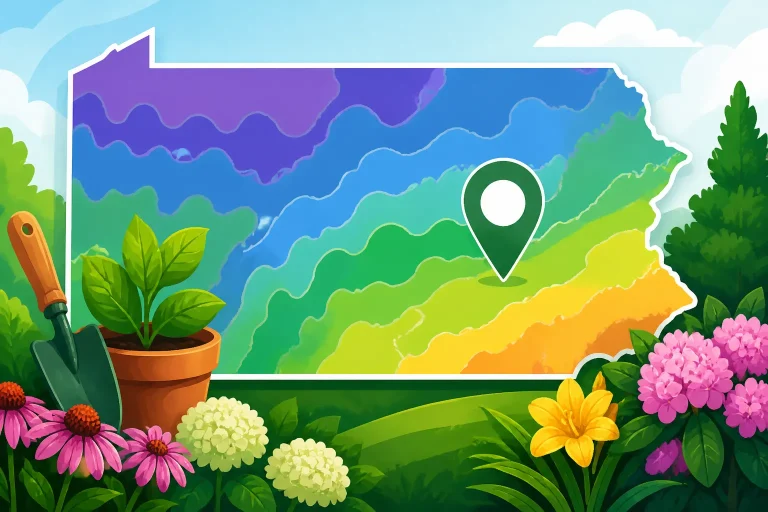
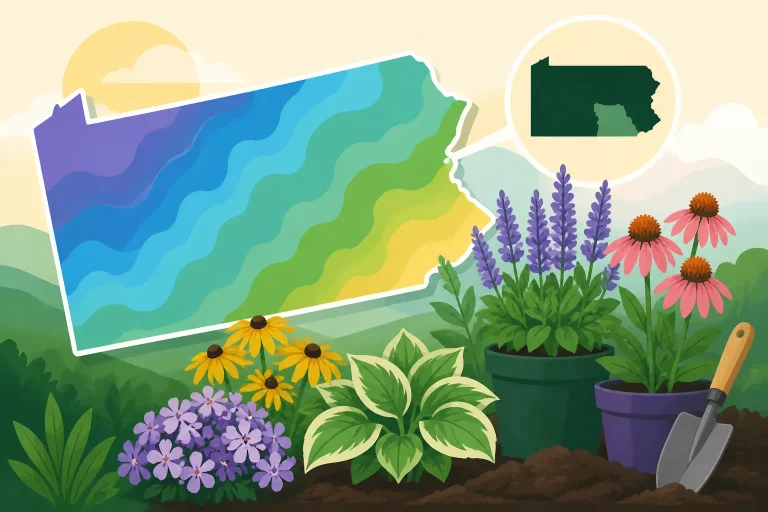
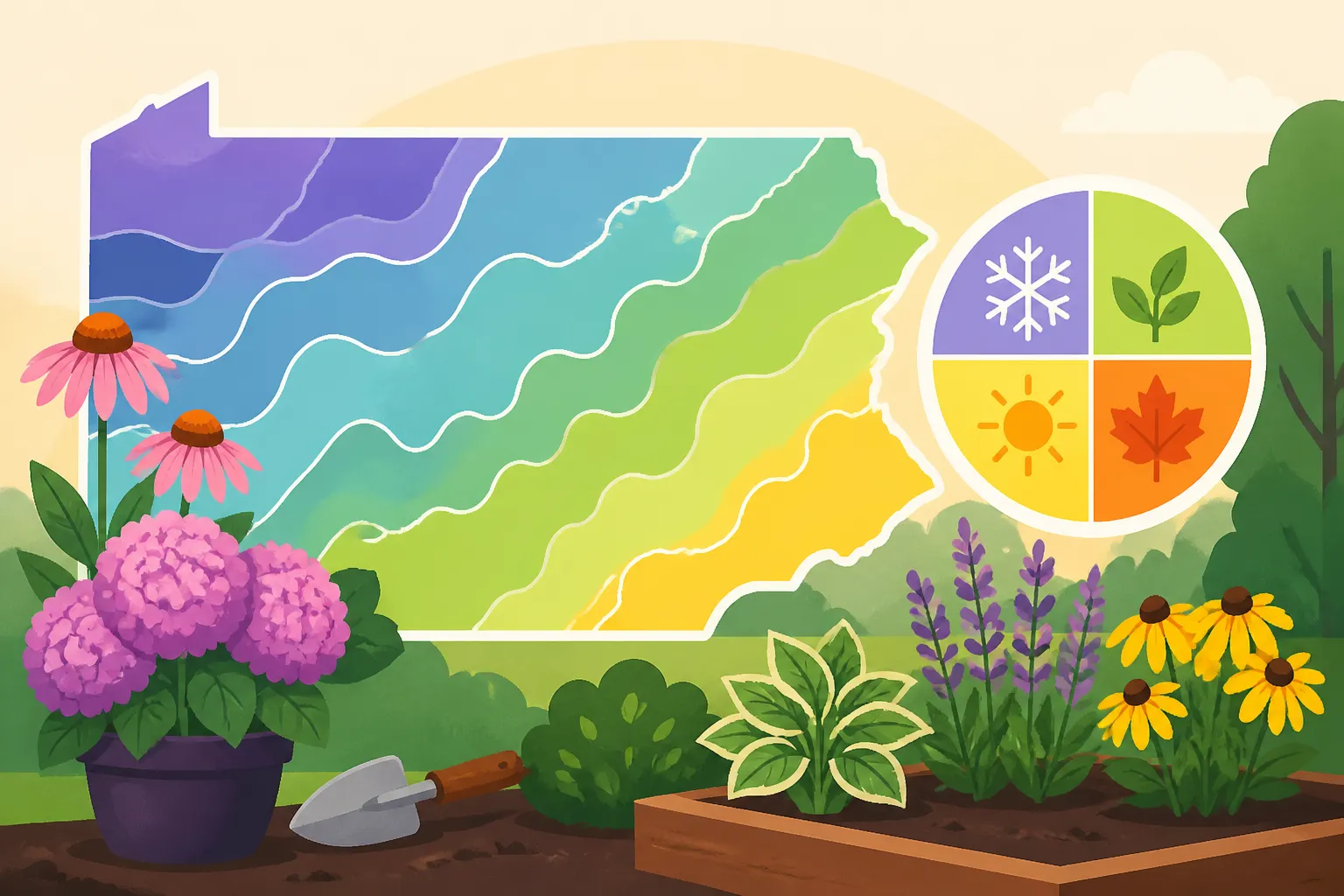
Penn State Extension says the hardiness map divides zones into colder ‘a’ and warmer ‘b’ half-zones spanning 5°F each. The letter is a refinement within a numbered zone: the “a” half is colder, while the “b” half is warmer. The distinction can help when comparing plant labels or map areas, but it does not mean that every place within a half-zone has identical winter conditions.
A zone is best read as a general signal about winter minimums. If a plant is rated for conditions colder than those typical of your map area, it may be a more dependable choice for outdoor winter survival. If its rating suggests it needs milder winters, growing it outdoors may involve more risk or extra protection. Even a plant with a suitable rating can struggle if it is stressed, poorly established, planted in wet soil, or exposed to conditions that differ from the general map.
For a closer look at how the map represents Pennsylvania places, see Pennsylvania Hardiness Zones: Finding Your Town on the Map. To understand the broader idea behind the map, Understanding USDA Plant Hardiness Zones When Buying Perennials is a useful companion.
What hardiness zones do not tell you
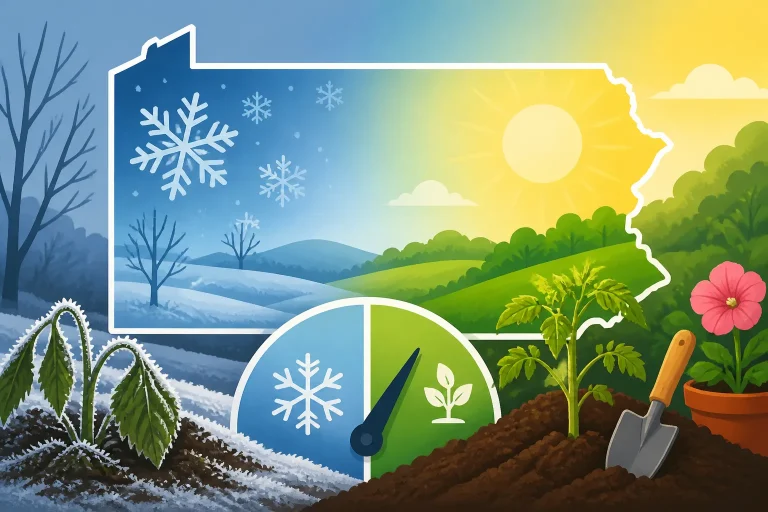
The most common mistake is to treat a hardiness zone as a planting calendar. A zone describes winter cold tolerance; it does not set a safe date for sowing seeds or moving tender plants outdoors in spring. A garden can be in a zone that suits a warm-season crop over winter, yet still experience a spring frost that would damage that crop soon after planting.
That distinction matters especially for vegetables and annual flowers. Many of these plants are grown for one season rather than expected to survive winter in the ground. Their outdoor timing depends on seasonal temperatures, frost risk, soil conditions, and the plant’s tolerance of cool weather—not simply on the zone assigned to the area. For timing decisions, use Hardiness Zones vs Frost Dates: When Can You Actually Plant? and Why Hardiness Zones Measure Winter Lows, Not Spring Planting Dates.
A zone also does not guarantee that every plant rated for it will thrive. A perennial’s winter survival depends on more than the lowest cold it can endure. How long cold conditions last, whether the soil stays saturated, how exposed the plant is to wind, and whether it entered winter in good condition can all affect the outcome. A label is a screening tool, not a promise.
Nor does a zone capture the full growing environment. It cannot tell you whether your garden is shaded by buildings, heated by nearby pavement, exposed to wind, or located in a low spot where cold air collects. It does not describe the soil’s texture, drainage, fertility, or moisture. These conditions often determine whether a plant that is technically hardy will actually perform well.
A useful way to think about the map is that it answers a narrow question: does the winter cold typical of this broad area appear compatible with this plant’s winter tolerance? Other questions—such as whether the site is sunny enough, whether the plant can handle damp soil, or whether it is safe to plant now—need different information.
Before buying, identify what kind of plant you are choosing. A long-lived shrub or perennial needs to cope with winter where it is planted. A vegetable that will be harvested within the growing season has a different set of concerns. For both, match the plant to the site, but do not use a winter-hardiness rating as a substitute for a seasonal planting plan.
Why Pennsylvania gardeners should look beyond the map
Pennsylvania is not one uniform garden environment. Terrain, elevation, exposure, built-up areas, and the layout of an individual property can create meaningful differences in conditions. Two gardens that appear close on a broad map may not experience the same exposure to wind, cold air, sun, or moisture.
The map is meant to summarize conditions across areas, not to describe every garden bed. A broad zone boundary can pass near a community, and the map cannot show every difference between a sheltered urban yard and an open, elevated site. Even within a property, the front of a house, a low lawn, and a sunny raised bed can behave differently.
Local geography matters because cold air does not affect every site in the same way. A low area may hold colder air on certain nights, while a slope can have different exposure. A wall or other structure can influence temperatures nearby, and pavement can change the feel of a planting spot. These effects do not redraw the map, but they can change how well a particular plant copes with the conditions where it actually grows. How Yard Microclimates Can Shift Your Planting Conditions explains why the location within a yard can matter as much as the map color.
The practical takeaway is not to ignore the zone. Use it to narrow plant choices, then examine the planting site. Look at whether the spot is sheltered or exposed, whether it tends to stay wet, and whether it receives the sun the plant needs. Consider whether cold air settles in the area and whether nearby structures may change its exposure. If you have had repeated winter losses in a particular bed, treat that history as useful local evidence rather than assuming the map alone must be right.
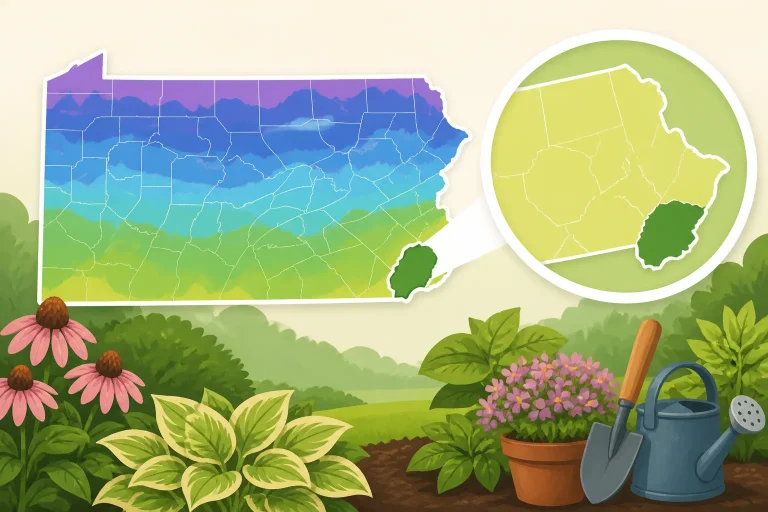
A map can also simplify a transition between neighboring areas. If your location seems close to a zone boundary, avoid making a high-stakes decision based only on the color of a small map patch. Check the location carefully and compare the map’s indication with the conditions you observe. Why Hardiness Zone Maps Disagree on Your Pennsylvania County and Navigating Split Zone Boundaries Across Pennsylvania Counties can help explain why a county or ZIP code may not have a single neat answer.
It is also worth separating local variation from a map error. A plant can fare poorly in a yard even if the area’s zone rating seems suitable. That does not necessarily mean the map is wrong; the problem may be drainage, exposure, establishment, or another feature that the map does not represent. Conversely, a sheltered spot may let a plant do better than its broad map rating suggests. Neither outcome guarantees success elsewhere in the same community.
How to use a zone when choosing plants
Use the zone as a first filter, then make a site-specific choice. This approach is more dependable than buying from a label alone or deciding that a plant is impossible because of a broad map reading.
Start by checking the plant’s stated winter hardiness. Compare that information with the zone associated with your location, including the half-zone detail where it is available. If the label indicates that the plant is suited to colder conditions than your area typically experiences, it may be a more conservative choice for overwintering outdoors. If it calls for milder conditions, decide whether you are willing to accept uncertainty, provide suitable protection, or grow the plant in a container that can be moved.
Then consider what the plant needs besides winter survival. Check light, soil moisture, drainage, and mature size. A plant can meet the winter-hardiness requirement and still fail because it is placed in deep shade, crowded by neighboring plants, or planted in soil that stays too wet. Matching those needs is as important as choosing a compatible zone rating.
When comparing similar plants, think about the consequences of a loss. A replacement perennial may be disappointing but manageable. A large tree or a costly landscape installation deserves more careful checking because replacing it can take time and effort. If the plant is a major part of a design, seek a choice whose winter needs fit the site comfortably rather than relying on a marginal match.
Nursery labels need careful reading. The rating may describe a broad range, and the exact way it is presented can vary. Check whether the information refers to the plant’s ability to survive winter, and do not confuse that with how well it will grow or bloom in your yard. Reading Nursery Labels: What Zone Ratings Mean for Pennsylvania offers more context on interpreting those labels.
| What you are deciding | How the zone helps | What to check beyond the zone |
|---|---|---|
| Choosing a perennial for an outdoor bed | Screens for likely compatibility with winter cold | Soil drainage, light, exposure, and establishment |
| Selecting a shrub or tree | Helps compare winter tolerance among choices | Mature size, site conditions, and the cost of replacing a poor fit |
| Deciding whether to grow a tender plant outdoors | Signals whether winter survival may be uncertain | Whether the plant can be protected, moved, or grown seasonally |
| Planning spring vegetable planting | Offers little direct guidance about a safe planting date | Frost risk, crop tolerance, soil conditions, and current weather |
| Comparing plants with different label ratings | Helps identify which has more winter margin | The exact label wording and the conditions in the planting spot |
For any plant that is only marginally suited to the site, ask whether there is a practical way to reduce risk. A protected location, a container that can be moved, or a different plant with a more suitable rating may be options, depending on the species and your garden. Avoid assuming that a covering or sheltered placement will change the plant’s underlying hardiness; it may only influence the conditions it experiences in that location.
If you are unsure how to interpret the map for your location, use the map lookup process described in How to Look Up Your Pennsylvania ZIP Code on the USDA Zone Map. A ZIP code is a convenient way to orient yourself, but it should not be treated as a precise forecast for a particular bed or address.
How to read zone maps and labels without overreading them
Maps are visual summaries, and their colors can make boundaries look sharper than local conditions really are. A colored area represents a broad classification, not a guarantee that every site within it experiences the same winter. Look for the zone information associated with your place, but keep the map’s scale and purpose in mind.
When a map provides half-zones, read the letter and number together rather than looking only at the number. The letter distinguishes the colder or warmer half within that zone. This can matter when a plant label gives a narrow hardiness range or when you are comparing nearby map areas. It is still a regional guide, not a measurement taken in your yard.
Be cautious when using an online search result or a general location description. A town or county can cover varied terrain, and a ZIP code may not line up perfectly with a local climate boundary. If different tools appear to give different answers, check that they refer to the same map and interpret the result as a broad indication rather than an exact local reading.
Plant labels also deserve more than a quick glance. Some labels emphasize winter hardiness, while others focus on bloom, size, or care. Look for the hardiness information and compare it with your site. If the label is unclear, consult the retailer or a reliable plant reference before making a substantial purchase. The absence of a clear rating does not prove that a plant cannot grow in Pennsylvania; it means you need more information before treating it as a dependable outdoor perennial.
Avoid reading a zone rating as a complete quality score. A plant that is rated for colder winter conditions is not automatically better for every Pennsylvania garden. It may still require soil or light conditions that your site cannot provide. A plant with a narrower winter margin might suit a sheltered garden or a container if you are willing to manage that risk. The right choice depends on your goals and the effort you are prepared to put into care.
If your experience differs from what the map suggests, record what happened and where. Note the plant, the planting location, drainage, exposure, and whether it was newly planted or established. Over time, these observations can help you distinguish recurring site problems from a mismatch between the plant and the broad winter conditions. They are especially useful when a yard contains both protected and exposed beds.
The map is most useful when used with other information, not when treated as a single answer. Compare it with the plant’s care requirements, your site’s exposure, and the timing information relevant to the task. For spring vegetables and flowers, look separately at frost and planting guidance. For overwintering perennials, focus on hardiness and the specific conditions of the bed.
Combine hardiness zones with frost and planting timing
A hardiness zone does not tell you when frost will occur in spring or autumn. That distinction is central to using a planting calendar well. Winter survival is about whether a perennial can endure cold over time; spring planting safety is about whether a young or tender plant can tolerate the conditions it will encounter after planting.
For vegetables, the right planting window depends on the crop. Some tolerate cool conditions better than others, and seed sowing is not the same decision as transplanting a tender start. A warm-season crop can be damaged by cold weather even in a place where its mature plant might grow well through summer. A calendar should therefore be used as a regional guide and adjusted to local conditions, rather than inferred from the hardiness zone.
For indoor-started plants, consider both the outdoor conditions and the plant’s readiness to move. A seedling raised indoors may need to adjust gradually to outdoor light, wind, and temperature. A zone rating does not describe that transition. Planning for acclimation and checking the conditions near planting time are separate steps from checking winter hardiness.
For fall planting, the same distinction applies in reverse. A plant may be winter-hardy once established but still need suitable conditions to settle in before winter. The zone can help assess whether the plant is a reasonable long-term choice, but it does not identify the right date for planting or guarantee that a new planting will establish well. Consider the plant’s growth habit, the state of the soil, and local seasonal conditions.
Use a calendar that is designed for the crop or task at hand. Pennsylvania Vegetable Sowing and Transplanting Calendar can help organize vegetable timing, while When Is It Safe to Plant in Pennsylvania? Last-Frost Benchmarks focuses on the question a zone map cannot answer. The articles Spring Frost Probabilities and Garden Planting in Pennsylvania and NOAA Freeze Stations: Planning Around Pennsylvania Frost Dates provide additional context for planning around spring cold.
Keep the decision process practical:
- For a perennial, use the zone to screen for winter compatibility, then check the plant’s site requirements.
- For a vegetable or annual, identify the crop’s tolerance and use planting guidance suited to that crop.
- For a transplant, consider its readiness for outdoor conditions as well as the forecast and seasonal risk.
- For a borderline plant, decide whether its value is worth the possibility of winter damage or replacement.
- For a site with recurring cold problems, use local observations to adjust where and what you plant.
A planting calendar and a zone map are complementary tools, not competing ones. The zone helps with broad choices about plants that remain outdoors. Frost and crop-specific timing help with decisions about when to sow or transplant. Microclimate observations help refine both.
Build a Pennsylvania garden plan around the right evidence
A reliable garden plan uses the map for what it can do and adds the information it leaves out. Begin with the plants you want to grow and decide which ones need to survive outdoors through winter. For those plants, compare the hardiness information with your location and investigate any close or uncertain match.
Next, assess the actual planting spot. Check whether it is sunny or shaded, open to wind or sheltered, and well drained or persistently damp. Consider whether cold air tends to collect there. The same plant can have different prospects in separate parts of a yard, so plan for the bed rather than relying only on the general location.
For seasonal crops, work from crop-specific sowing and transplanting recommendations. Do not use the zone as a shortcut for a spring date. If a calendar offers a general window, compare it with current conditions and your own site. A warm spell does not necessarily mean the risk of cold has passed, and a map cannot make that judgment for a particular planting day.
Keep the plan flexible. You can choose dependable plants for the most exposed or important beds, while trying a more marginal plant in a protected spot or container if you want to experiment. If a plant struggles, reconsider the conditions before drawing conclusions about its rating. Poor drainage, inadequate light, a difficult establishment period, and winter exposure can all affect results.
A simple record can improve future choices. Note what survived, where it grew, and what conditions seemed to affect it. Record whether a plant was newly installed or established, whether it had a sheltered position, and whether the soil remained wet. This does not replace a map or a plant label, but it helps translate general information into knowledge about your own yard.
When buying plants, use the zone rating as a screening tool and read the rest of the care information. A suitable rating does not eliminate the need to match light, soil, and moisture. If a plant is outside the conditions indicated for your location, you may still decide to grow it, but make the trade-off deliberately rather than expecting the map to guarantee success.
Finally, treat all map-based guidance as a starting point. Your garden’s microclimate, plant care, and seasonal weather shape the outcome. A good Pennsylvania planting plan pairs hardiness information with local observation and the right calendar for the plant you are growing.
Frequently Asked Questions
Does a higher zone number mean a plant will always survive winter?
No. A zone rating is a broad guide to winter tolerance, not a guarantee. Site conditions, plant health, drainage, exposure, and establishment can all affect survival.
Can I use my hardiness zone to choose a spring planting date?
No. The zone describes winter cold tolerance, not the timing of spring frost or a safe date for transplanting. Use crop-specific planting guidance and local frost information.
What does the “a” or “b” mean on a zone map?
Penn State Extension describes “a” as the colder half-zone and “b” as the warmer half-zone. The letter refines the map’s classification but does not describe every condition in an individual yard.
Should I ignore the zone if my garden seems warmer or colder?
No. Use it as regional context, then account for your garden’s exposure, drainage, and other local conditions. A yard’s microclimate can influence how a plant performs without changing the broad map classification.
Disclaimer
This article is for general informational purposes only and does not constitute professional advice. Laws, prices and regulations vary by location and change over time. Consult a qualified professional for guidance on your specific situation. Pennsylvania Gardening Guide is not a government agency and is not affiliated with any university extension, state department of agriculture or other government agency.